Kuwalyst Media Planner

A single workspace for planning, monitoring and optimisation.

Build a plan from your data or audited benchmarks, monitor it against your goals and work through recommendations as new evidence becomes available. The source behind each number remains visible throughout.
The Kuwalyst Media Planner in motion: three budget scenarios compared side by side with the recommended one highlighted, the committed plan and its rationale, goals and an alert on Operate, a recommendation on Tune, and the assistant acting on the plan.
The product

Five connected views of the same plan.

Follow the planning process from what is working this week and what to do next, through to your commitments, the portfolio they belong to and the data and models that support them.

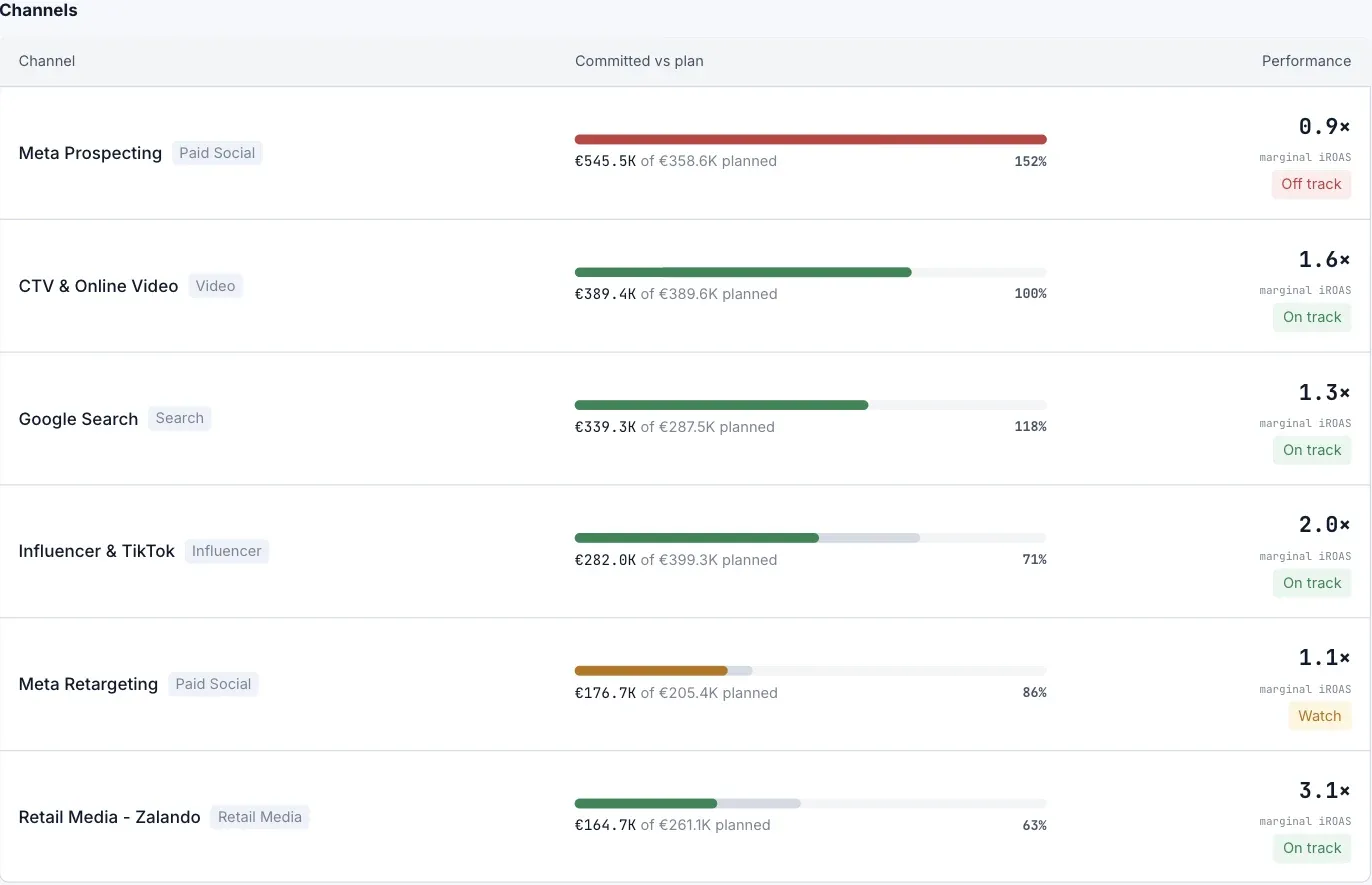
Channel table: committed versus planned spend, marginal iROAS and status per channel.
Operate

Understand how each euro is contributing this week.

Review each channel's committed spend against plan, marginal incremental ROAS and current status. Goals sit alongside the channel view, identified as projected or measured and shown with their target and trend. Weekly and monthly reports explain what changed and where attention is needed.

  • Goals with provenance tags and targets
  • Funnel progression against the plan
  • Channel table with marginal iROAS
  • Weekly and monthly reports, written from the computed figures
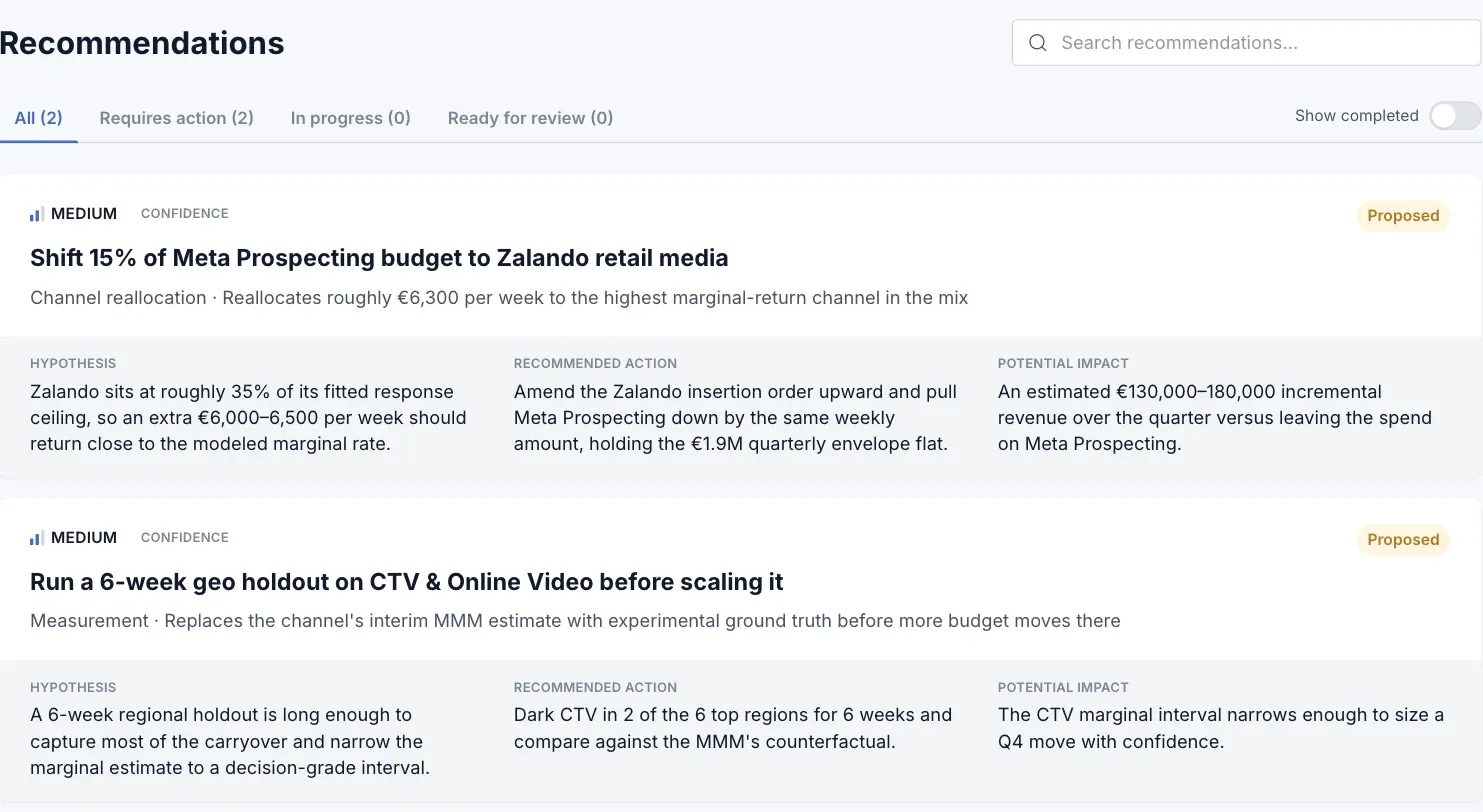
Two recommendations: shift budget from Meta Prospecting to retail media, and run a six-week geo holdout on CTV before scaling it.
Tune

Recommendations supported by clear evidence.

Each recommendation explains its hypothesis, proposed action, expected impact and confidence rating. You can accept, defer or reject it, and the planner records the decision. Where evidence is limited, measurement recommendations propose an experiment that can replace a modelled figure with a measured one.

  • Hypothesis, action, potential impact
  • Confidence rating on every recommendation
  • Proposed, in progress, ready for review
  • Experiments proposed from the first plan
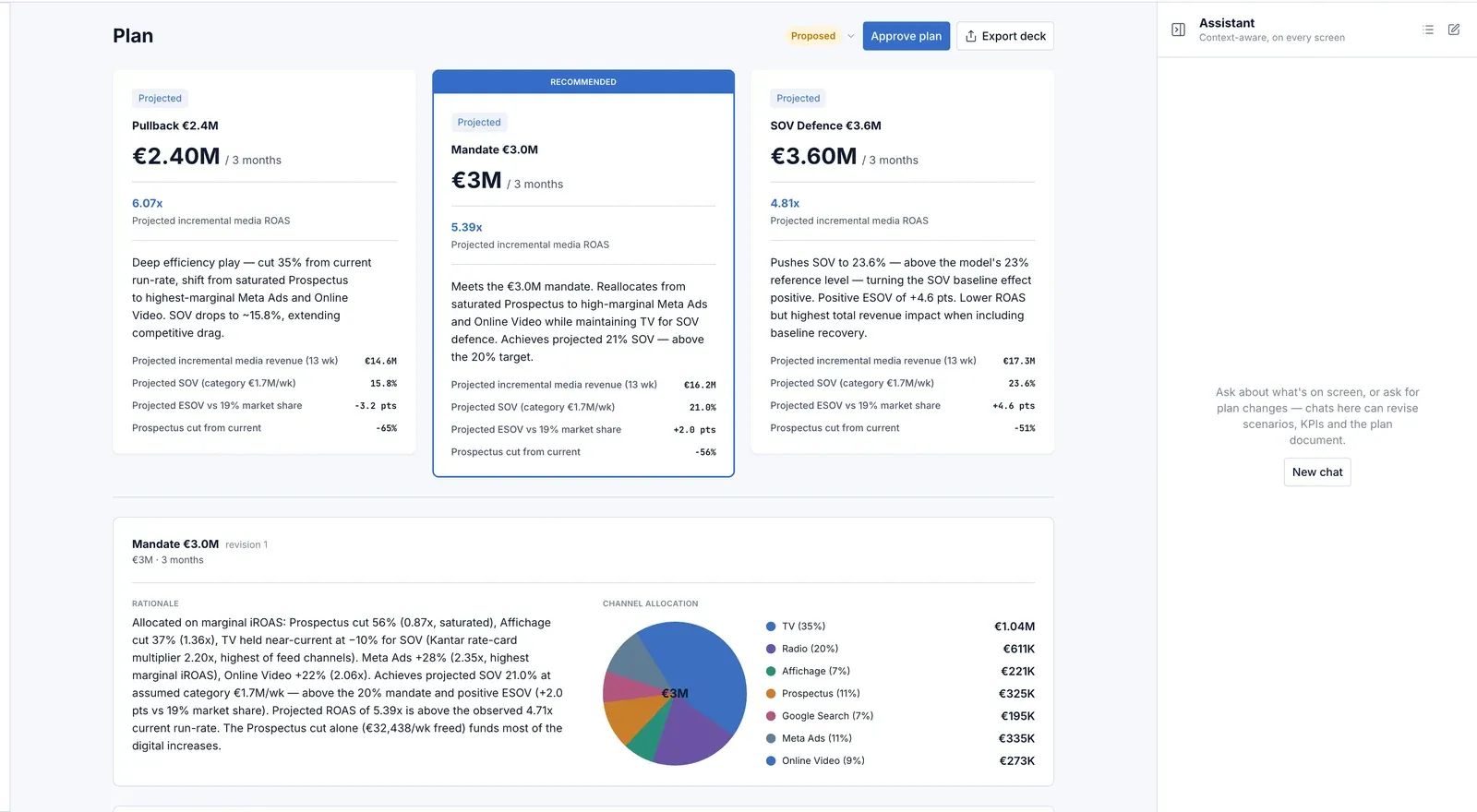
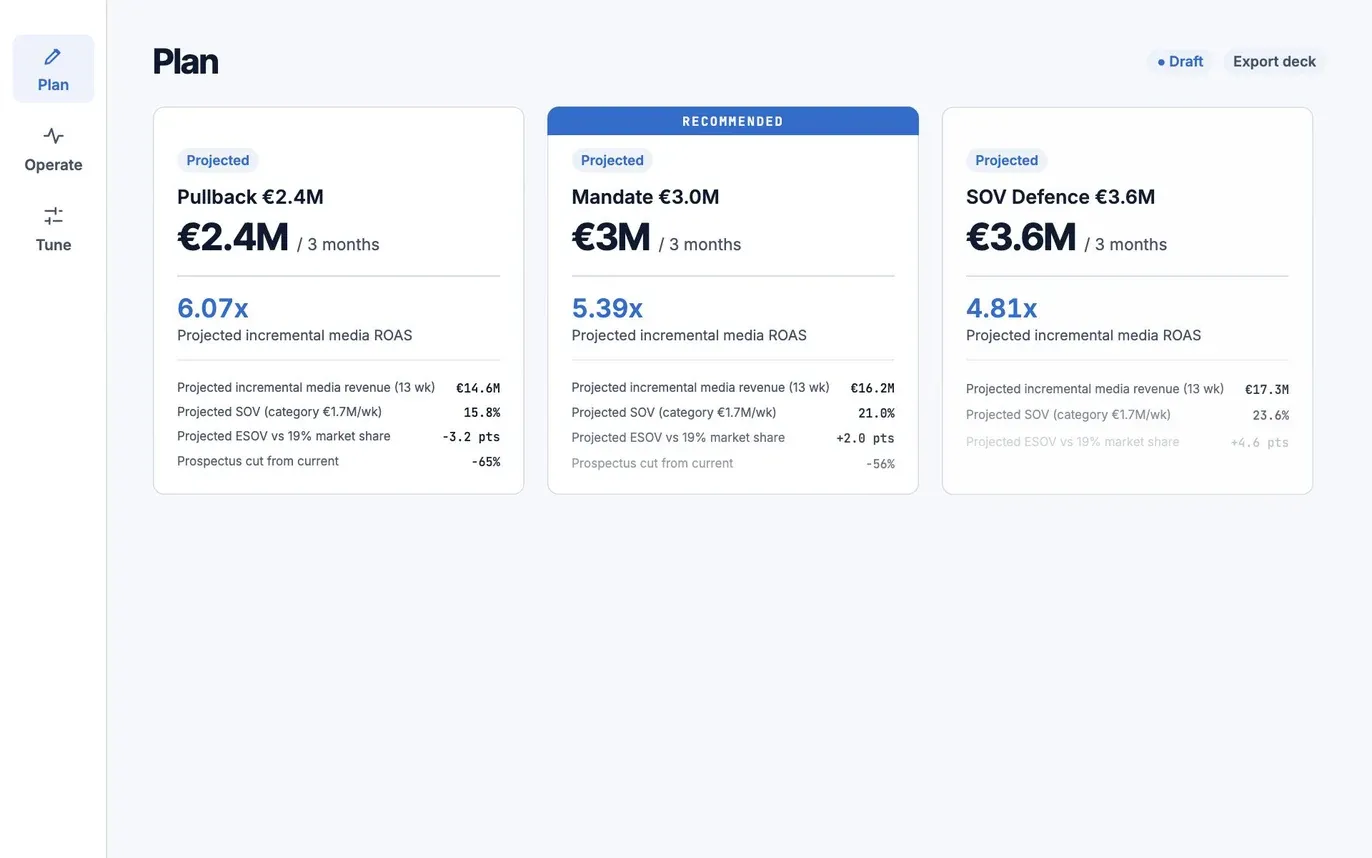
Three scenarios compared side by side, the camera moving from the pullback to the recommended mandate and the share-of-voice defence.
Plan

Compare scenarios before committing budget.

Compare allocations side by side, with each option showing its projected blended return, uncertainty range, trade-offs and the guardrails it does or does not meet. Once you commit to a scenario, the planner prepares the plan document, rationale and presentation export.

  • Growth, balanced and efficiency scenarios
  • Projected ROAS with its band
  • Rationale in plain words
  • Plan document and deck export
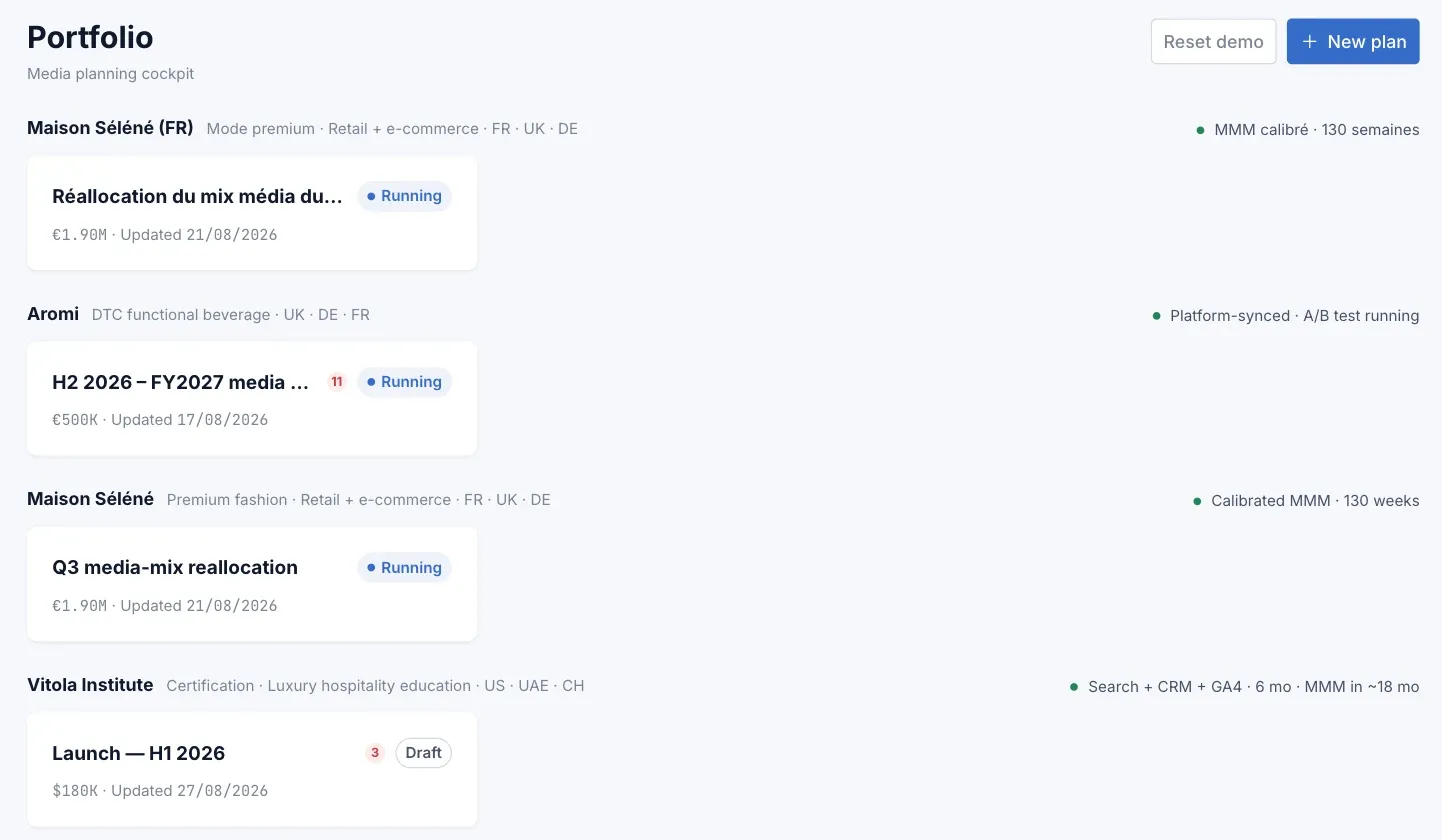
The portfolio cockpit: four demo brands, each with its running or draft plan and the data it stands on.
Portfolio

A clear portfolio view across every brand and plan.

Designed for teams managing more than one brand, the portfolio shows the evidence available for each one: a calibrated MMM, platform synchronisation or an active A/B test. Plans that need attention are easy to identify.

  • Brands and their plans in one view
  • Data maturity stated per brand
  • What requires action, counted
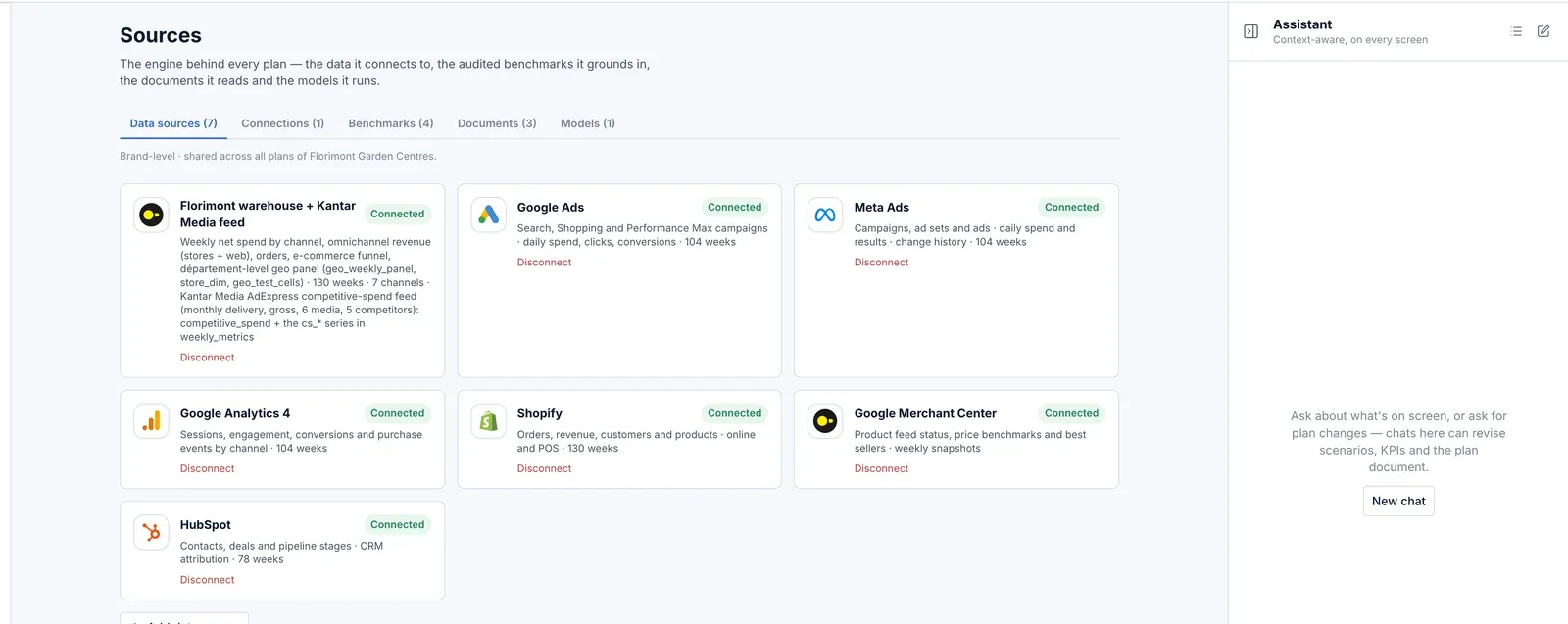
Sources: seven connected data sources — the brand warehouse with the Kantar feed, Google Ads, Meta Ads, Google Analytics 4, Shopify, Google Merchant Center and HubSpot — beside the benchmarks, documents and models tabs.
Sources

The data and methods that support each plan.

The planner connects to your data, audited benchmarks, documents and models across online and offline channels. Its connectors cover warehouses, ad platforms, analytics, CRM, e-commerce and flat files, and it can also connect to MCP servers and agent skills developed by your team.

  • Data warehouses: Snowflake, Google BigQuery, Amazon Redshift
  • Paid media: Google Ads, Meta Ads, LinkedIn Ads, TikTok Ads
  • Web and app analytics: Google Analytics, Mixpanel
  • CRM and sales: Salesforce, HubSpot
  • E-commerce and payments: Shopify, Stripe
  • Email: Mailchimp
  • Files and local databases: CSV, Excel, Google Sheets, DuckDB
  • Benchmark registry, 200+ audited sources
  • Briefs and strategy documents
  • MMM artifacts, including models your team already built
Control

Choose the level of autonomy that suits your team.

You decide which actions the planner can take. Each level of autonomy operates within the guardrails and limits you set.

Auto-pilot

The planner can take low-risk actions within limits you set, such as spend caps and reversal windows, while keeping you informed.

ExamplePausing a keyword with zero conversions.

One-click approval

Medium-risk actions are presented for review and can be approved in one click, with thresholds you control for each channel.

ExampleA budget reallocation the MMM recommends.

Manual review

High-risk actions come with a full briefing before you decide. On higher plans, a Kuwalyst marketing scientist can join the review.

ExampleStopping a campaign or changing a bidding strategy.

Two starting points

Start with the evidence you have today.

Benchmark-led

If first-party data is not yet available, the plan can be based on your brief and the audited benchmark registry. Each figure is identified clearly, along with the most useful tests to run first.

Data-backed

With a data warehouse and an MMM, allocations can follow the marginal incremental ROAS shown by the model's response curves, rather than relying on an average return.

Also from Kuwalyst

Kuwalyst AI Analyst for Shopify

Your AI analyst inside Shopify admin: what changed in sales, products, inventory and customers, where it came from, and what to check next. In early access, free.

See Kuwalyst AI Analyst for Shopify
Sovereign by design

Your data, and the AI that processes it, remain in the EU.

The planner uses Scaleway Generative APIs, hosted in the EU (France). Privately hosted models are available on request, including on-premise and VPC deployments.

Pricing

Pricing that reflects how you choose to work.

License the platform for your own team, or work with our marketing scientists on optimisation and execution. Agencies can license a single workspace for their client portfolio.

See pricing
Proof

The planner makes uncertainty visible when evidence is incomplete.

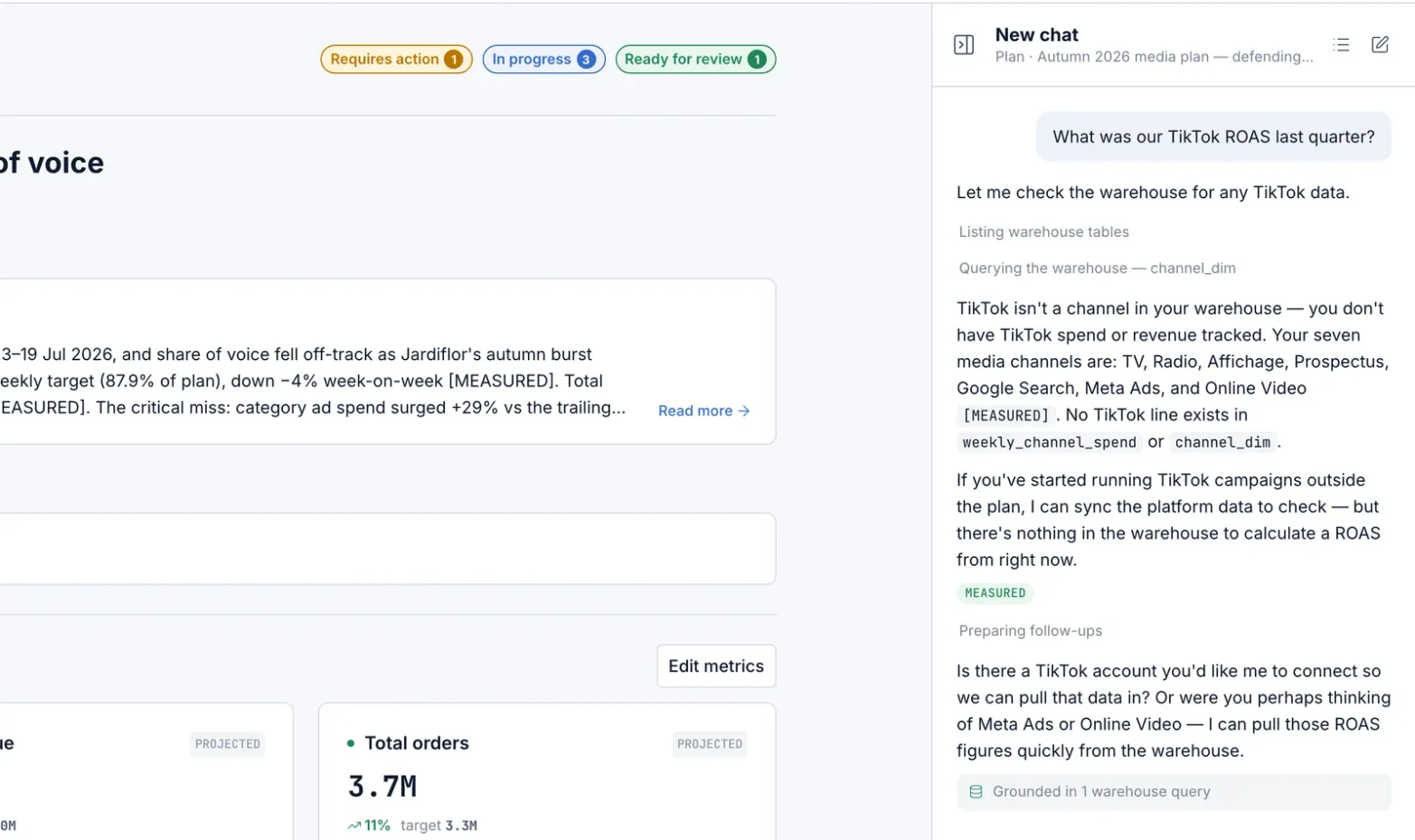
“TikTok isn't a channel in your warehouse — you don't have TikTok spend or revenue tracked. There's nothing in the warehouse to calculate a ROAS from right now.”
The planner, asked for last quarter's TikTok ROAS on a brand that has never run TikTok. It checked the warehouse before answering, and offered the nearest tracked channels instead.
TikTok isn't a channel in your warehouse — you don't have TikTok spend or revenue tracked. There's nothing in the warehouse to calculate a ROAS from right now.

A first plan within an hour

Begin with audited benchmarks when data is not yet available, then move to a data-backed plan as evidence builds.

200+ audited benchmark sources

Each traced to its primary publisher. The sourcing policy is part of the registry.

Every figure tagged

Figures are identified as measured, projected or benchmarked on every screen and in every export.

Contact

See how the planner could support your own situation.

Bring a brief, spreadsheet or data warehouse, and we will show you what a first plan could look like within an hour.

Talk to us